
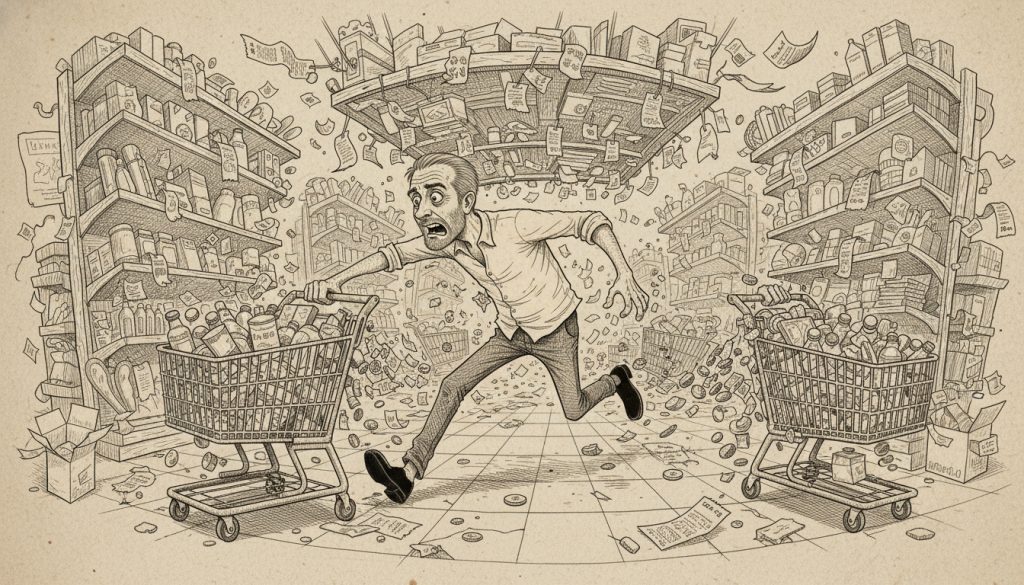
Your funnel deck is lying. People don’t march from awareness to purchase because you colored the stages pretty. They wander. They stall. They forget you exist for six weeks, then resurface with a coupon from a rival. You call it seasonality. I call it denial.
Call it the retail customer journey if you need the slide to land, but stop pretending it’s a moving walkway. It’s a crowded aisle with a floor that keeps shifting, comparison tabs breeding in the browser, and a cart with one loud wheel that screams at checkout. You don’t lose revenue at the end. You bleed it at every turn. The hard truth: you’re not underperforming because the market is tough. You’re underperforming because you built a straight hallway and your customers live in a maze.
Here’s the part everyone avoids saying out loud. Most teams confuse output with progress. More campaigns. More channels. More noise. Then they stare at a dashboard wondering why the dial won’t move. It’s not your media mix. It’s your leaks. And they’re boring, tiny, and absolutely savage.
Fine. Here’s Where The Retail Customer Journey Actually Counts
This isn’t about worshiping a model. It’s about respecting the physics of attention. When you simplify what is messy, you blunt every touchpoint. You can spend seven figures and still lose to a competitor with a cleaner return policy and a faster page. That’s not pessimism. That’s accounting.
Retention isn’t romantic, it’s profitable. Plug one hesitation and the margin compounds. Miss it and your team keeps hauling water into a bucket with a hole. The quiet fixes are the ones that sweat: load time, clarity, trust signals, the one field your checkout doesn’t need. They feel small until you calculate how many carts die in the last 30 feet.
And yes, the models help. Journey mapping exposes where people hesitate, not where you hope they move. It’s a mirror, not a mood board. Use it to find the places where your story stops making sense, then rebuild those sentences until money stops escaping.
Take a breath. Now we turn chaos into steps.
Start Small, Start Visible
Focus on one part of the retail customer journey that causes the biggest hang-up. Maybe it’s the product page or the checkout flow. Fixing that one snag can give you measurable wins fast. It’s tempting to overhaul everything at once, but quick, clear results build momentum and avoid wasted effort.
Build the Version That Scales
Once you nail down a critical segment of the retail customer journey, make sure the solution works at scale. That means automating where you can and creating systems that handle more customers without falling apart. If a fix only helps a handful of users, it’s not really fixed.
Run the Review Loop
Check your changes regularly. The retail customer journey shifts as competitors move or consumer habits change. Set a cadence for reviewing customer feedback and performance data. Make adjustments before those little problems grow into big ones.
Know When It’s Working (and When It’s Not)
Don’t just look at broad metrics like total sales. Dig into the specific signals that reflect how customers move through your journey. Track drop-off points, email click-throughs after cart abandonment, or time spent on product pages. These details tell you what’s working well and what needs another round of fixes.
Retail journey optimization depends heavily on detailed customer journey mapping. Journey mapping has evolved with AI and real-time orchestration powering customer experience strategies, allowing marketers to identify friction points such as complicated checkouts or confusing navigation that cost sales CMSWire.
LEGO used an “Experience Wheel” visualization to pinpoint areas where loyalty program members became disengaged, making it easier for teams to spot and address issues quickly. Similarly, in the UK, a retailer working with Kaizen reduced staff time on non-value-adding tasks by 82%, freeing over 35,000 hours annually to focus on personalized service, directly improving sales and customer satisfaction Kaizen.
Empowering teams with tools like mobile POS and clienteling apps, along with offering immersive in-store experiences such as AR/VR try-ons, can create more engaging journeys. Personalization and seamless omnichannel integration are key to building loyalty and advocacy, as highlighted by boutique agencies and practitioners who focus on incremental, data-driven improvements Chattermill, Smart Tribune.
Paul Hamilton, Brand & Customer Director at Five Guys, noted the importance of data at the store level: “To continue delivering exceptional experiences for our customers, we need insights that inspire action at a store-by-store level. Chattermill enables this by unifying our CX data, analyzing it at scale using deep learning AI, and delivering insights that help us understand the Five Guys customer experience at a granular level.” These insights guide improvements and overall brand strategy Chattermill.
Measurement of retail journey improvements now tracks conversion rates, retention, NPS (Net Promoter Score), CSAT (Customer Satisfaction), customer effort scores, and attribution analytics. Some projects have seen double-digit increases in sales and productivity by combining creative fixes with technology-driven insights Genesys.
Omnichannel strategies blending physical and digital touchpoints and proactive customer feedback loops are increasingly essential. The retail customer journey must be continuously mapped, reviewed, and optimized to keep pace with changing consumer habits and competitive pressures Voyado, Shopify.
Last Receipt Before The Lights Flicker
Here’s the part you don’t put on a slide: most losses are quiet. They hide in a form label that confuses, a shipping estimate that scares, a promise you almost keep. You don’t need a louder story. You need fewer places for trust to die. Map the maze. Fix the squeaks. Let the boring work do the shouting.
Keep pretending it’s linear and you’ll keep sweeping coins off the floor.
If you’re done improvising your growth plan, we help companies turn chaos into systems that actually ship. Book a Strategy Session.