
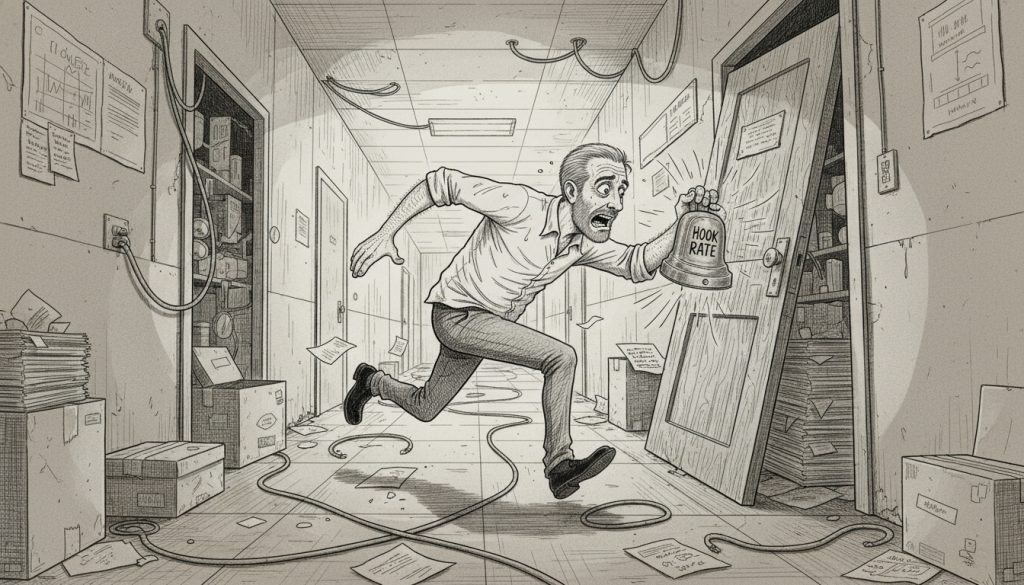
I just walked out of a meeting where a 41 percent hook rate got treated like a trophy. High fives, charts, victory tone. No one asked what broke after the click. That is how budgets die.
Here is the quiet part at full volume. Hook rate is not the win. It is the adrenaline shot before surgery. If you stop there, you celebrate a pulse and ignore the patient. Most teams are so hungry for a number that goes up, they will light money to protect it. Clicks, opens, 3 seconds of a view, a skim that never becomes a step. You bought attention and called it progress.
The lie is comfortable. If the top line spikes, leadership relaxes, the update sounds brave, and everyone pretends the rest of the funnel will recover on its own. It will not. A shiny hook with a dead follow-up is a drain. You did not win, you widened the gap between what you promised and what you deliver. That gap is where trust leaks out.
You want to fix this. Start by naming the disease. If your story cannot carry beyond the hello, your growth engine is a turnstile. People enter, people exit, revenue stands still. The hook is the doorbell. If the hallway is blocked, you just paid for knocks that go nowhere.
Fine. Here’s Where Hook Rate Earns Its Keep
Yes, hook rate matters. It is the first gate. If you cannot stop the scroll, open the email, or spark the first second of curiosity, nothing else can happen. Treat it like ignition, not arrival.
But the raw number without context is a false god. A low hook rate tells you the promise is weak, the packaging is off, or you aimed at the wrong crowd. A high hook rate with no follow-through says you baited with one thing and handed them another. That is not clever, that is a refund you have not met yet.
Picture the classic confusion spiral. Your ad nails a 30 percent hook rate. The room cheers. Then you see only 5 percent of those people buy or sign up. That 25 points of engagement is not an asset, it is noise you paid to create. You tuned the lure and ignored the path.
Hook rate is a signal, not a win condition. It tells you where the first loss happens. If you fail at the front door, fix the promise and creative first. If you spike at the door and die in the hallway, fix the path. Diagnose in order. Anything else is malpractice.
Context is the point. Channel norms matter. Audience intent matters. The ask you attach to that initial spark matters most. The headline, the visual, the first 3 seconds, they need to match the landing page, the time-to-value, the next yes. If those elements do not rhyme, your report will sing while your pipeline goes quiet.
Take a breath. Now use the energy to do the work.
Start Small, Start Visible
Focus on improving your hook rate in a controlled way. Test small variations in headlines, creatives, or calls to action and see what changes the initial engagement. Don’t overhaul everything at once. Start with one channel or audience segment and measure the hook rate carefully.
Build the Version That Scales
Once you identify what improves hook rate, adapt those learnings into your broader strategy. Document what hooks work and why. Get your teams aligned so everyone understands the role hook rate plays in the bigger funnel. You want a repeatable process, not one-off wins.
Run the Review Loop
Make reviewing hook rate a regular habit. Look for patterns where the hook rate spikes or drops. Review why those changes happened and adjust quickly. Don’t let the number slide or get ignored until it becomes a problem.
Know When It’s Working (and When It’s Not)
Hook rate is a diagnostic tool. If it’s improving but conversions are stagnant, your problem lies after the hook. If hook rate tanks, fix the entry point first. Track how hook rate correlates to real outcomes to use it confidently. Treat it like an early warning light, not a destination.
According to Winsome Marketing, “The hook rate is a measure of how effectively your content captures audience attention in the initial moments of exposure. It’s particularly important in video ads measured by the percentage of viewers who watch the first crucial few seconds of your video.” This metric acts as a “scroll-stopping” score that indicates how well your ad captures initial attention, often measured as the percentage of 3-second video plays over impressions on platforms like TikTok and Meta.
Benchmarks suggest a hook rate of around 40%+ on TikTok and 35–45% on Meta is elite, while anything below 25% signals a weak hook needing creative revision. This strongly supports your point that a low hook rate means the first impression is failing and costs money without meaningful engagement.
Furthermore, a key insight is that if hook rate improves but conversions do not, the problem lies downstream in the funnel, validating the need to diagnose beyond vanity metrics early in the campaign process.
Kill The Applause, Check The Wiring
Here is the hard truth that does not fit on a victory slide. Attention is rented. Trust is earned. If you confuse the first for the second, you will keep buying louder intros while the middle act starves. The meter will tick up, the board will nod, and your pipeline will whisper the answer you keep ignoring.
Stop treating the hello like the handshake was the deal. Align the promise, the path, and the payoff, then let the hook rate tell you where the heat escapes. Otherwise you are polishing the bell while the doors stay locked.
If you’re done improvising your growth plan, we help companies turn chaos into systems that actually ship. Book a Strategy Session.