
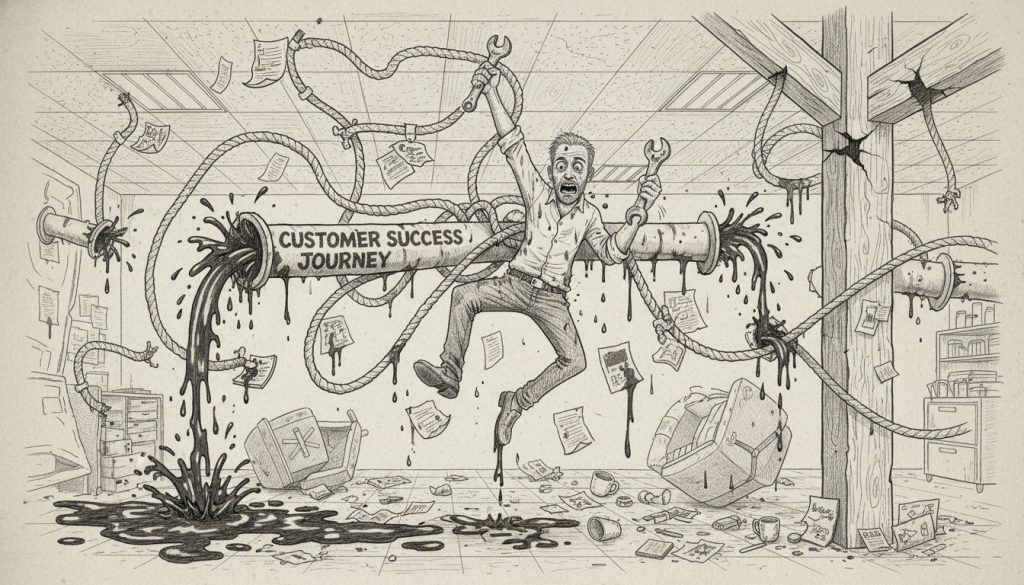
You treat onboarding like a casserole. Toss in emails, a checklist, a kickoff call, then wait for magic. The magic never shows.
Here is the quiet part said out loud. The customer success journey is not a to-do list. It is a daily triage line where attention wins and autopilot bleeds you dry. Most teams ship the welcome email, light a candle, and call it retention. Then they wonder why month three looks like a cliff.
You do not have a churn problem. You have a negligence problem. And it starts in the first hour, keeps compounding by the first week, and bankrupts you by the first quarter. If a CMO can read your onboarding flow without wincing, you are not onboarding. You are hoping.
Okay, Fine. Here’s Where the customer success journey Actually Pays Rent
Yes, I’m roasting the system because the system makes it easy to hide. But it also gives you the levers that matter. When it works, it tampers with gravity. When it doesn’t, your acquisition dollar gets fed into a wood chipper.
When the handoffs wobble, churn spikes. People get lost before they ever see value. Then you spend twice to re-win ghosts or chase colder leads. Math time no one likes. Bring in 1,000 new accounts. Only 70 percent finish onboarding. That is 300 early exits. At 50 dollars a month, that is 15,000 dollars walking out every 30 days. Not a forecast. A hole in the bucket you drilled yourself.
So no, this is not a cute exercise in customer empathy. This is the operating system for lifetime value. Everything you say you care about hangs on it. Activation. Adoption. Expansion. Advocacy. Touch any one without fixing the path and you are just rearranging chairs.
Here’s the breath where we trade noise for motion
Start Small, Start Visible
Focus on a single key milestone in the customer success journey and improve it first. It could be the onboarding email that gets ignored or the first login experience. Fixing one small point visibly can create momentum. When your team sees an improvement, they’ll buy in for the next push.
Systemize What’s Actually Working
After you nail one stage, build repeatable processes around it. Document what works so you aren’t reinventing the wheel every time. Automation helps, but only if triggered by real customer behavior — not assumptions. The customer success journey becomes manageable only when you can replicate wins reliably.
Make It a Habit, Not a One-Off
Consistently check in with your customers along the journey. This isn’t about sending generic surveys. It’s about reviewing their progress, understanding pain points, and adjusting communications. This habit keeps your team connected to the real experience, not just the ideal process.
Know When It’s Working (and When It’s Not)
Use data to spot early warning signs like stalled onboarding steps or dropping feature usage. Don’t rely solely on dashboards. Spend time looking at actual user behavior and qualitative feedback. Being proactive means addressing issues before customers churn.
Key Lessons from Customer Success Journey Case Studies
Let’s stop pretending every path is snowflake science. The teams that win find the common spine, then personalize at the edges.
Comeet did exactly that. They identified shared checkpoints across segments, then kept the right flavor of personalization where it mattered. The result was consistent engagement points and clearer satisfaction reads across their base. They also treated alignment like mission control. Sales, support, and success worked inside integrated systems with clean handoffs and fewer oh-no moments between stages. Fewer handoff stumbles, faster time to value.
They did not chase high-touch for everyone. They split the field. Automated the right motions for lower-touch customers, kept human attention for accounts where nuance pays back. Operational steps got cut in half. That is not a slide. That is time, reclaimed and reinvested.
A separate B2B journey study showed the obvious you keep skipping. Every phase needs a different tool. In awareness, content should connect to pain, not poetry. In consideration, real depth wins, not slogans. In decision, give trials, demos, and support with a pulse. After purchase, stay present with follow-ups and feedback loops or watch loyalty decay.
Personalization drove engagement across the entire arc. Not the creepy kind. The useful kind. Teams that gathered better customer data, segmented by real differences, and spoke to individual challenges saw satisfaction climb and conversion move in the right direction.
Another organization pushed journey-centric design and documented the work. Detailed maps tied to business outcomes, not vibes. They quantified what partial interactions were costing and modeled the lift from fixing them. Then they earned receipts. Application dropoff down 12 percent. Tool adoption doubled. Not because they worked harder, but because the path made sense.
And yes, case studies do double duty. They sell for you, but they also bind customers closer. Show real problems solved, invite customers into the story, and the relationship deepens. That is not vanity. That is community with receipts.
Final lesson across all of it. Success is not universal. It is personal. You can run a tight operation, stack your systems cleanly, and still miss what a given customer calls a win. Your job is to hold both truths at once. The shared checkpoints and the private definition of done.
Understanding Project Retrospectives in Customer Success
Retrospectives are not group therapy. They are the place you cash the check your process keeps writing. In customer success, they align sales and success around what actually happened during onboarding, not what the deck promised. That alignment tightens the entire journey.
The Role of Retrospectives in Customer Success
Project retrospectives help immediate teams understand where things went well and what can be improved. When applied to customer success, these meetings create a collaborative space where Customer Success and Sales can reflect on the completed customer onboarding period, celebrate accomplishments, and pinpoint insights that enhance the onboarding experience going forward.
By leveraging a structured process, CS and Sales can align efforts, share learnings, and tune the onboarding journey. The result is fewer surprises, tighter handoffs, and a smoother first mile for customers.
Key Purposes of Customer Success Retrospectives
- Creates a safe space to solve problems together
- Encourages collaboration to tackle challenges
- Spots opportunities to improve workflows and customer outcomes
- Celebrates team achievements and acknowledges hurdles
- Promotes continuous growth and strong teamwork
- Prevents repeating past mistakes by addressing them head-on
- Builds trust and learning through reflection and joint problem-solving
Practical Approaches for Customer Success Retrospectives
Customer Journey Mapping Method
Map the whole arc on a timeline. Plot major events, bright spots, and friction. Seeing the path beats arguing about it. This view builds empathy, exposes waste, and reveals upgrades that make the next engagement run cleaner.
Gathering Client Feedback
Send a post-project survey with pointed questions. Capture the customer’s take on success and misses. Pair it with structured handoffs like onboarding checklists, live handoff meetings between sales and success, and welcome packets that set expectations on day one.
Assessing Project Outcomes
Retrospectives should include questions focused on outcomes that measure client satisfaction and whether objectives were met:
- Did the project meet all client requirements and expectations?
- Were deliverables completed to a high standard of quality?
- Did the project stay within budget?
- How satisfied were clients with the final product?
- What feedback did clients provide regarding the deliverables?
Building Empathy Across Teams
Pull in leadership and sponsors. Let them see the typical journey, where it sang, where it dragged. Patterns appear. Shared memory forms. Then you can craft plays for the recurring obstacles instead of reinventing heroics every quarter.
Last Word Before The Lights Cut
Here is the part no one puts on the roadmap. Retention is built in the unglamorous minutes when someone notices the wobble and fixes it before it becomes a story. Most teams collect these minutes like loose screws in a drawer, then wonder why the product rattles.
You do not need more noise. You need fewer excuses.
If you’re done improvising your growth plan, we help companies turn chaos into systems that actually ship. Book a Strategy Session.