
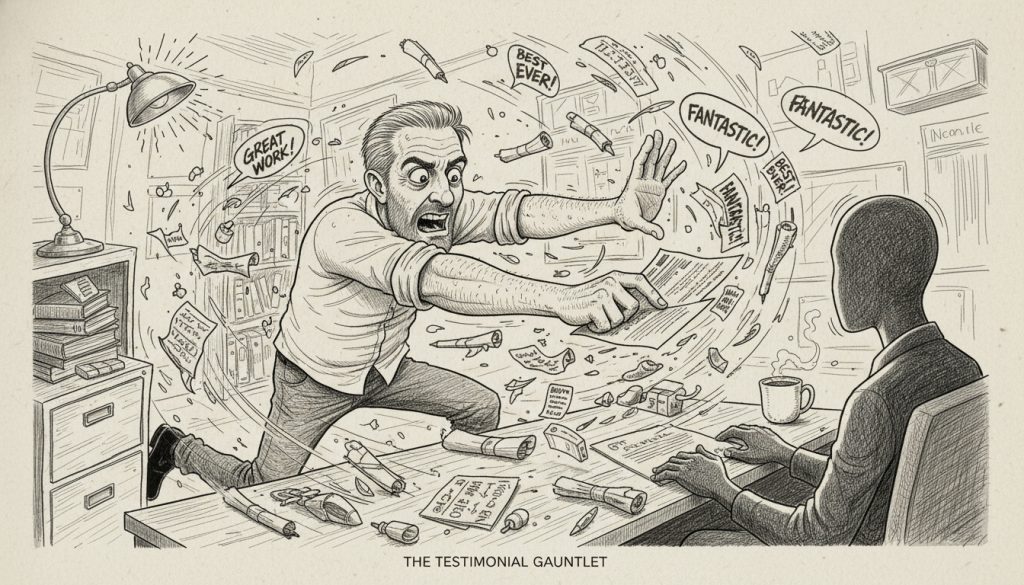
You keep promising proof, then go scavenging for quotes after the confetti is swept up. The story is over. The emotion cooled. And you wonder why everything you collect reads like elevator small talk.
People keep googling how to ask for a testimonial from a client like there’s a magic sentence that solves shame. There isn’t. There is timing. There is nerve. There is a process you actually run. If you wait, you get polite blur. If you ask at the peak, you get details that cut through inboxes and procurement decks. That gap is the difference between social proof and social wallpaper.
Stop pretending it’s optional. You want demand, but you treat proof like a lost-and-found. Ask late, and you get nostalgia. Ask early, and you get news. It’s not complicated, it’s uncomfortable. And yes, if you didn’t plan the ask before the milestone, you already decided to settle for vague praise.
Okay, Fine. how to ask for a testimonial from a client Actually Matters
Here’s the unglamorous truth. Testimonials are the shortest bridge between stranger and trust, and you build that bridge with a clock, not a thesaurus. The system is dumb because it requires you to be brave at inconvenient moments. The system is useful because real outcomes in a client’s mouth beat any headline you can pay for.
Ask too late and enthusiasm degrades into corporate memory. Ask too early and it feels like you’re fishing before the boat leaves the dock. The sweet spot is when the win is fresh, the metric is visible, and the human who felt it still remembers the texture of the problem. That’s when specifics spill out. That’s when quotable lines surface on their own.
You don’t need longer quotes. You need sharper ones. Names, titles, numbers, one change that mattered. Earn permission. Respect their time. Then reuse the same asset across proposals, ads, and nurture for a year. It’s boring. It works. The only risky part is asking while the moment is still warm.
Exhale. Now run the play exactly once, then forever.
Here’s a concise approach you can reuse.
1. Timing and channel
- Ask soon after a win (project completion, visible results, positive feedback).
- Use the channel you already use with them: email, WhatsApp, LinkedIn, or in person.
2. What to say (simple script)
You can adapt this email/message:
Hi [Name],
I’ve really enjoyed working with you on [project]. I’m putting together a few short client testimonials and would love to include your experience.
To make it easy, you can just reply in a few sentences to any of these:
– What did you appreciate most about working together?
– What changed or improved for you after our work?
– What would you tell someone considering working with me?Is it OK to use your name and company when I share this on my website and marketing materials?
Thank you again for your trust and for any feedback you’re willing to share.
[Your name]
This uses open-ended questions instead of a blank request, which makes it much easier for clients to respond, as explained by Senja.
3. Make it easy
- Limit to 3–4 short questions so it’s not overwhelming.
- Offer options: quick reply by email, a short form, or a 60‑second video/voice note if that’s easier.
- Include consent in the same message (name, title, photo, where you’ll use it).
4. If they’re busy: draft it for them
If you already know what they liked, you can write a short draft testimonial and let them edit/approve it, which saves time for them. Bonsai suggests:
“Based on our work, I drafted this — feel free to change anything:
‘Working with [Your Name] on [project] helped us [result]. I especially appreciated [strength].’
Does this reflect your experience, or would you adjust it?”
5. Gentle follow‑up
If they haven’t responded in a week or two, send a short nudge:
Hi [Name], just bumping this in case it slipped your mind. Even 2–3 sentences about your experience would be hugely appreciated.
According to Bonsai, this approach respects client time and optimizes response rates.
The Part You Don’t Want To Hear
If this feels beneath you, that’s the problem. Proof beats posture. The teams that win treat testimonials like inventory, not souvenirs. They schedule the ask. They collect names and numbers while the paint is still drying. They stop waiting for perfect and start banking real.
Here’s what you’ve been standing in: a shelf of wins with no labels. No one buys unlabeled jars. Put names on the glass.
If you’re done improvising your growth plan, we help companies turn chaos into systems that actually ship. Book a Strategy Session.